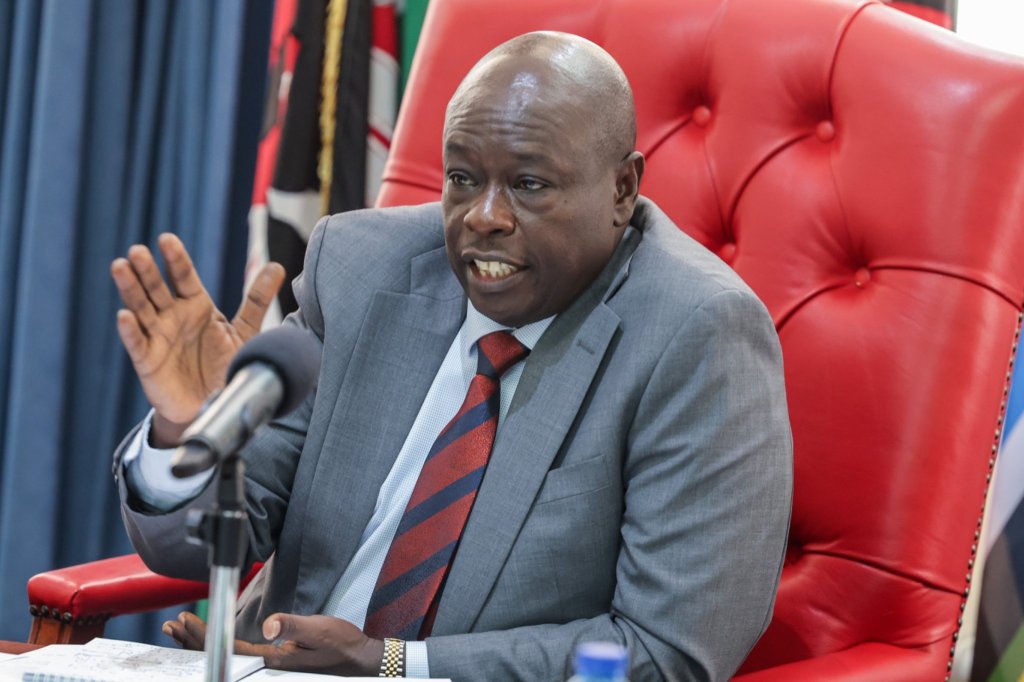
Deputy President, Rigathi Gachagua.
The impeachment of Deputy President Rigathi Gachagua is most definitely a matter of political manoeuvring but as Professor Kivutha Kibwana argues, it presents a significant constitutional challenge. On his Facebook page, Prof Kivutha who is a leading legal scholar and currently a lecturer in law at Daystar University, shared his analysis on the constitutional, legal, and procedural intricacies of the impeachment process. In this piece, the Anchor presents a simplified version of his analysis:
Understanding the Constitutional Framework
At the heart of the impeachment debate is Article 150 of the Kenyan Constitution. This article, when read in conjunction with Articles 144 and 145, sets forth the legal basis for removing a Deputy President from office. Article 150 provides that the Deputy President can be removed using the same procedures as the President. Article 144 outlines the process for removal due to physical or mental incapacity, while Article 145 allows impeachment for serious violations of the Constitution, gross misconduct, or criminal activity. The process involves the National Assembly, initiating the motion, followed by a trial in the Senate, where a two-thirds majority vote is needed for removal.
Kenya’s National Assembly is composed of 290 elected members representing constituencies, 47 women representatives elected from each county, 12 nominated members representing special interest groups such as youth and people with disabilities, and the Speaker, who is an ex-officio member. The nominated members are selected by political parties based on their proportional representation in the Assembly.
According to Prof Kivutha, the Constitution essentially mirrors the process used for the impeachment of a sitting President, applying it to the Deputy President with “necessary modifications.”
The key grounds for impeachment, as outlined in Articles 144 and 145, include:
- Gross violation of the Constitution or any other law
- Serious reasons to believe that the Deputy President has committed a crime under national or international law
- Gross misconduct
These are the same grounds that apply to the President’s removal. However, while these constitutional provisions exist, Prof Kivutha points out that the lack of an impeachment-specific law creates substantial confusion or uncertainty about the steps or rules in the process. This gap could lead to varying interpretations and procedural inconsistencies as the process moves forward.
The Impeachment Procedure Bill: A Missed Opportunity
In his analysis, Prof Kivutha draws attention to the Impeachment Procedure Bill (Senate Bill No. 15 of 2018), which aimed to establish a legal framework for the removal of high-ranking public officials. This Bill sought to address the procedural gaps in impeachment proceedings for the President, Deputy President, Cabinet Secretaries, Governors, and other officials. Unfortunately, as he notes, the Bill has yet to be passed by Parliament, leaving a void in Kenya’s legal landscape.
Had the Bill been enacted, it would have clarified several key issues. It would have set out detailed procedures for handling impeachment cases, ensured public participation in the process, and codified standards for handling such significant undertakings. Prof Kivutha argues that its absence leaves the current process more dependent on general constitutional provisions and the discretion of parliamentary committees, which could lead to inconsistencies or even constitutional challenges.
Key Legal and Procedural Challenges
Prof Kivutha identifies several important legal and procedural issues that arise from this lack of a detailed framework. Without the Impeachment Procedure Bill he writes, several questions remain unresolved:
- Senate’s Discretion in Impeachment: Article 150 of the Constitution allows for the Deputy President’s removal, but the exact scope of Senate’s discretion is unclear. Can the Senate exercise discretion even after substantiating grounds for removal? If so, what is the criteria for applying this discretion?
- Public Participation Requirements: One of the most significant aspects of Kenyan governance is the principle of public participation, enshrined in Article 10 of the Constitution. Impeaching a President or Deputy President, who were elected on a joint ticket, could arguably require an even higher standard of public participation than other officials. The fact that the Public Participation Bill of 2023 has also not been passed by Parliament further complicates the situation. How public input is gathered and assessed in this process will be a major point of focus.
- Quasi-Judicial Role of the Senate: The Constitution positions the Senate as a quasi-judicial body when presiding over an impeachment case. However, Prof Kivutha observes that the procedures for this role are not fully fleshed out in the Constitution. Without a detailed legal framework, the Senate is left to interpret its own powers, including how to adjudicate the case and what procedural safeguards to apply.
- Definition of Gross Misconduct: One of the grounds for impeachment is gross misconduct, but the Constitution does not define this term in detail. According to Prof Kivutha, this could lead to legal challenges or differing interpretations of what constitutes “gross misconduct” serious enough to justify removal from office.
The Role of Public Participation
Public participation is a constitutional requirement in Kenyan governance, and Prof Kivutha emphasises the critical importance of this principle in the current impeachment process. Citing landmark court cases like the Building Bridges Initiative (BBI) Case and the BAT Case, he points out that public participation must be genuine, meaningful, and more than a mere formality. In these cases, the courts laid down stringent standards for how public participation should be conducted, including ensuring that the public is adequately informed, given reasonable opportunities to participate, and that their input is considered in decision-making processes.
The lack of a formal law governing public participation in the impeachment process complicates matters further. In the absence of such legislation, the process must rely on existing judicial precedents and the general principles of public participation as outlined in the Constitution. Prof Kivutha raises the concern that, given the high-profile nature of impeaching a Deputy President, the public should be more deeply involved and educated about the specifics of the charges and the legal basis for impeachment.
“Did the National Assembly and those who presided over the public participation events/spaces explain the meaning and impact of impeachment; legal process; as well as the entirety of the grounds so that the citizens could make an informed judgement? Significant civic education in relation to the cited laws within the eleven (11) grounds becomes key to securing effective public participation.”
Strategic Considerations for the Deputy President
Furthermore, Prof Kivutha explores the strategic implications for the Deputy President as he navigates the impeachment process. While the Constitution does not explicitly grant the Deputy President a right to be heard during National Assembly hearings, the current process has offered him an opportunity to defend himself. This has both advantages and disadvantages:
On the one hand, appearing before the National Assembly allows the Deputy President Gachagua to present his case, potentially convincing some MPs of his innocence or mitigating the charges against him. It also gives him a platform to sway public opinion, which could have a significant impact on the final decision. On the other hand, presenting evidence in the National Assembly exposes his defence strategy, which could be used against him when the case moves to the Senate. Furthermore, many MPs may have already formed their opinions, making it an uphill battle to shift the tide in his favour. (As of the time of publishing the National Assembly had voted to impeach the Deputy President.)
Prof Kivutha concludes by stating the impeachment of a Deputy President is a constitutional and legal test that will have far-reaching consequences for Kenya’s governance. As such, it is crucial that the process follows not only the letter but also the spirit of the law, ensuring that all constitutional principles are upheld, including the rule of law, public participation, and fair hearing.
Ultimately, this impeachment process could set a precedent for how future cases involving high-ranking officials are handled. Prof Kivutha stresses the importance of creating a robust legal framework for impeachment procedures, one that provides clarity, ensures fairness, and strengthens Kenya’s constitutional democracy.
This analysis, prepared by Steffany Ndei with the aid of AI tools, is based on Professor Kivutha Kibwana’s Facebook post published on October 6.
Leave a Reply