County’s Turmoil: A Deep Dive into Wavinya Senate Showdown
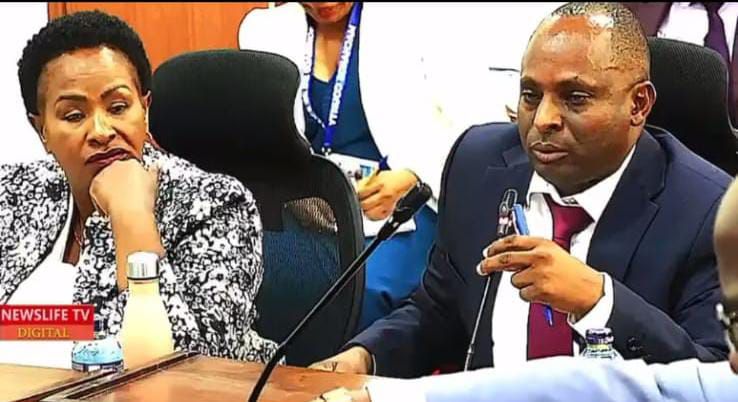
In a dramatic hearing that exposed troubling financial discrepancies, Machakos County Governor Wavinya Ndeti faced intense scrutiny from the Senate Public Accounts Committee.
The meeting, characterized by pointed questions and palpable tension, revealed significant gaps in the county’s financial records, raising serious concerns about accountability and governance.
I will sack you all
But even as the embarrassing episode exploded with Wavinya uttering two conflicting figures of 13 and 30 percent, the Governor told her finance minister Onesmus Kuyu in Kikamba, ” Nithi umuvuta inywonthe ” ( I’m going to dismiss you all).
At the heart of the Senate’s inquiry were discrepancies totaling over 2.6 billion Kenyan Shillings. The officials presented figures that starkly contrasted with data from the Integrated Financial Management Information System (IFMIS). For instance, the county reported an expenditure of 1.4 billion KES for “use of goods and services,” while IFMIS indicated only 737 million KES. This left a staggering shortfall of 663 million KES, a gap that neither Wavinya nor Kuyu could adequately explain.
Similar inconsistencies were evident in other financial accounts, including transfers to government entities and asset acquisitions, which also showcased discrepancies of 1.68 billion KES and 281 million KES, respectively. These figures have not only drawn sharp criticism from the Senate but have also cast a long shadow over the integrity of Machakos County’s financial practices.
Senator Moses Kajwang, chair of the Senate Public Accounts Committee, emphasized the seriousness of these discrepancies. He declared IFMIS as the “single source of truth” for county finances, underscoring the importance of transparency in managing public funds. His assertion that the reported expenditures raised “legitimate concerns of fabricated expenses” highlighted the potential for mismanagement that could involve ghost transactions or worse, outright theft of public resources.
Kuyu, who seemed increasingly defensive during the questioning, struggled to provide documentation for the missing funds. This lack of accountability incited frustration among Senate committee members, who questioned not just his competence but also his potential involvement in a wider network of financial malpractice.
As the head of Machakos County, Wavinya Ndeti bears ultimate responsibility for financial oversight. However, her failure to hold her finance team accountable has led to significant public disapproval. Critics argue that her inaction in the face of mounting evidence undermines her administration’s credibility.
The recent cabinet reshuffle, which notably left Kuyu in his position, raises further questions about her commitment to transparency and governance. The governor is seen as captive of a cabal of failures who are incompetent, reckless, and devoid of any capacity to advise the governor. It could also be that Wavinya is inadvisable, if not incorrigible.
Wavinya was in more trouble after introducing a number of Chief Officers serving in acting capacity.Senators questioned why Wavinya still had officers serving in acting capacity. The governor’s defense—that “appointments are a continuous process”—did little to assuage the concerns of the senators regarding the legality of key personnel serving in acting capacities.
Notably, two Chief Officers were revealed to be acting illegally, having not been vetted by the County Assembly, further complicating Wavinya’s position.
The fallout from this Senate hearing extends beyond the immediate financial discrepancies. It raises broader questions about governance in Machakos County and the integrity of public institutions. As Wavinya faces mounting pressure, the apparent disconnect between her administration and accountability measures could have lasting implications for public trust.


 The Anchor
Leave a comment